HamRadioIQby WildBone Outdoors Get the app

HF to UHF · 160 m to 70 cm

Know where to turn the dial.

See which bands look promising—and understand why. From daytime DX to after-dark openings, HamRadioIQ helps you read the conditions behind the contact.

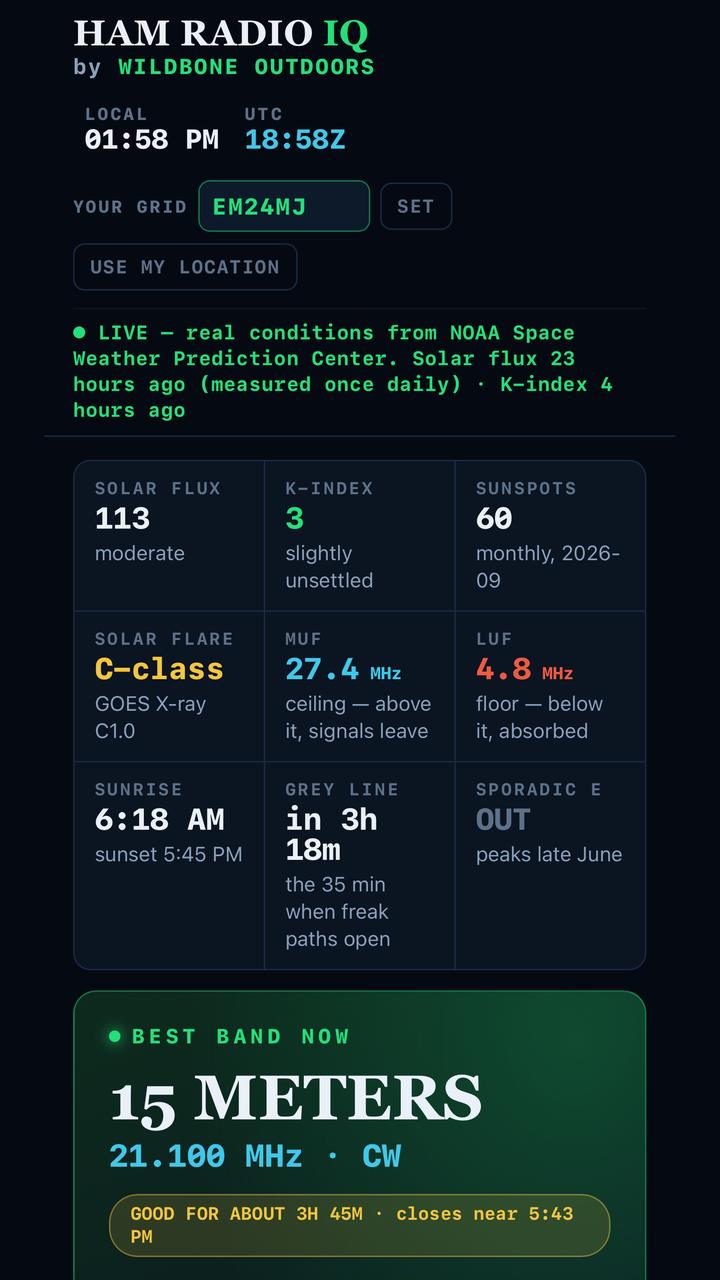
HamRadioIQ board: live NOAA solar flux 113, K-index 3, MUF 27.4 MHz, LUF 4.8 MHz, and best band now 15 meters

The real app. Live NOAA numbers, and 15 meters as the best band for this hour.

The IQ formula
  1. DATAtells us WHAT IS.
  2. MATHtells us HOW IT FITS TOGETHER.
  3. PHYSICStells us WHY IT HAPPENS.
  4. IQtells you WHAT TO DO WITH IT — and WHEN.

Turn propagation, bands and conditions into radio intelligence.

We don't just give you the answer. We teach you to understand it.

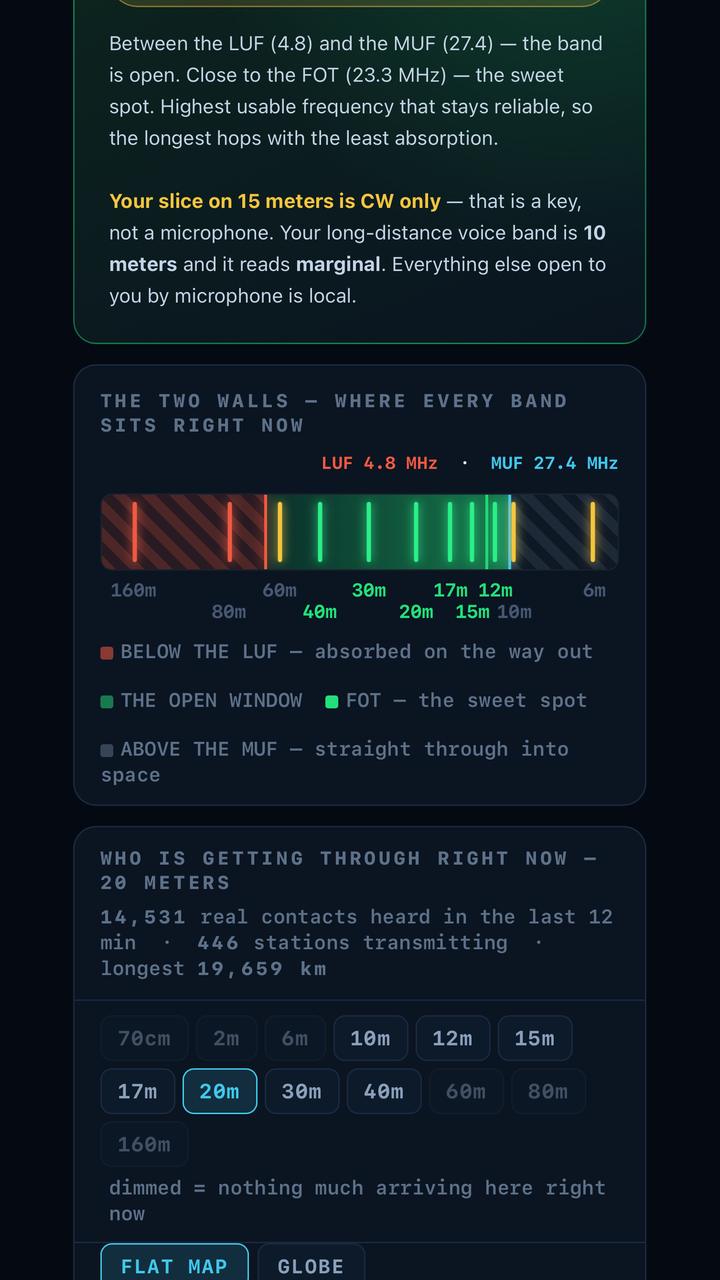
The two walls: LUF 4.8 MHz and MUF 27.4 MHz, with each band placed below, between or above them

Read the conditions.

What’s worth trying right now?

Connect propagation conditions with practical band choices. Learn what favors a band, what can limit it, and why the picture changes throughout the day.

The two walls · LUF 4.8 MHz · MUF 27.4 MHzBelow the LUF: absorbed on the way out. Above the MUF: straight through into space.

The two walls are the LUF and MUF. Bands between them are the ones worth a try.
Board showing sunrise 6:18 AM, sunset 5:45 PM, grey line in 3 hours 18 minutes, and best band now 15 meters

Follow the sun.

Why one band wakes up as another fades.

Explore how sunlight affects the ionosphere, why different HF bands favor different times, and what sunset can mean for your next contact.

Grey line · in 3h 18mThe 35 min when freak paths open. Sunrise 6:18 AM, sunset 5:45 PM.
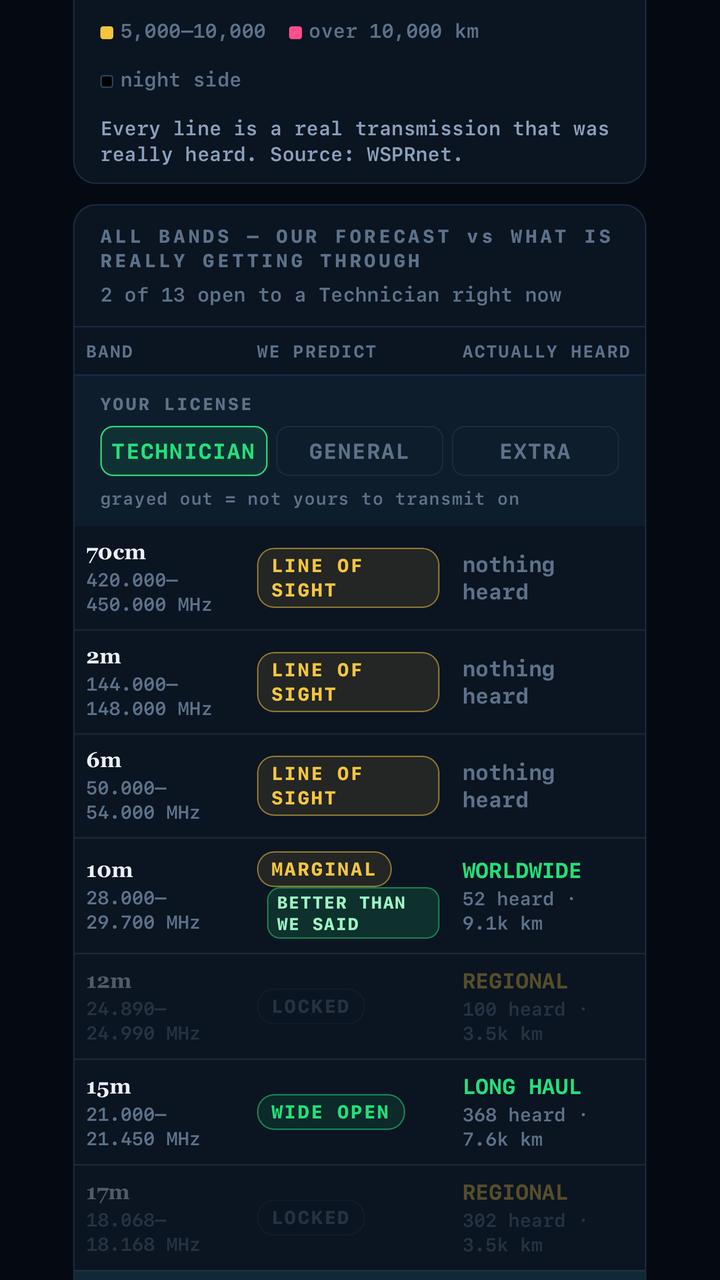
Live contact map: every line is a real WSPR transmission that was really heard

See what’s being heard.

Explore WSPR reception reports alongside the conditions.

The forecast says what should work. These reception reports show which signals have been heard, where and when. HamRadioIQ puts the two side by side, band by band.

Live map · source: WSPRnetEvery line is a real transmission that was really heard.
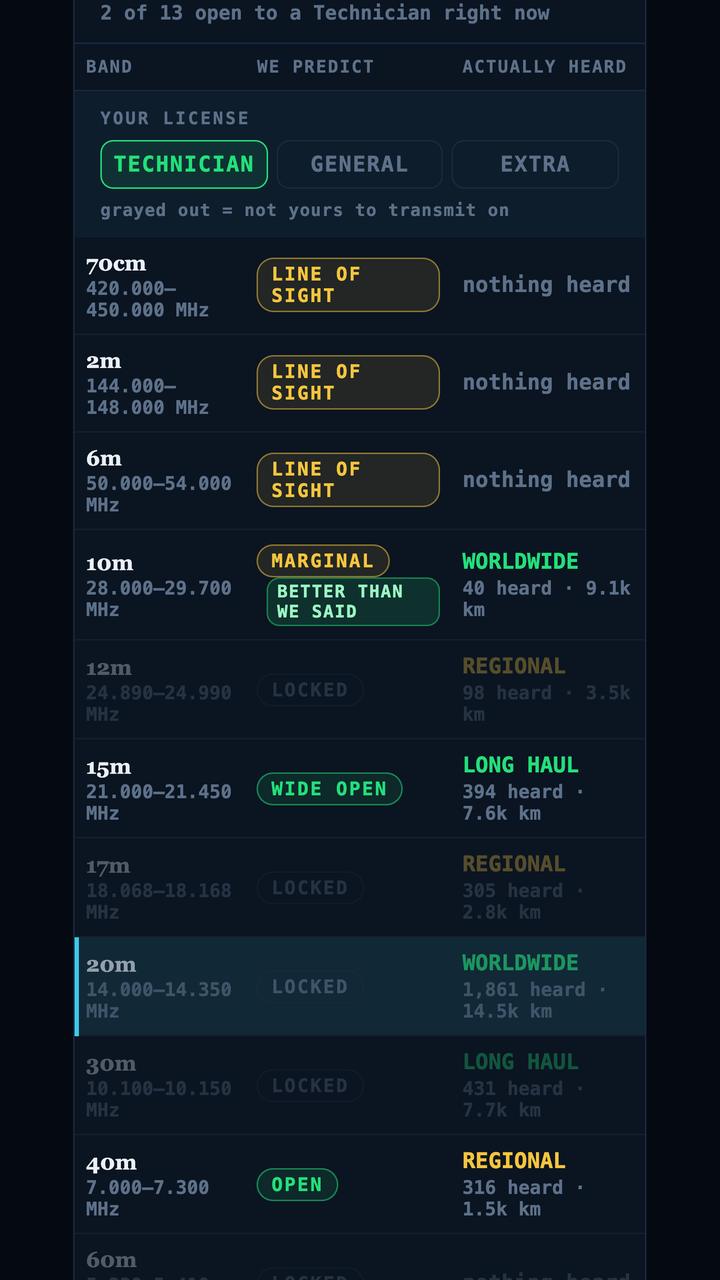
70 cm, 2 m and 6 m rows marked Line of Sight

Beyond the usual reach.

When the lower atmosphere opens up new possibilities.

Explore tropospheric enhancement and ducting—and how the right conditions can carry VHF and UHF signals beyond their usual reach.

2 m · line of sightNormal range — repeaters and local simplex. Ground weather decides the rest: a temperature inversion can duct this hundreds of miles.

Word for word from the app's read on a line-of-sight band.

Understand the conditions. Choose your band. Make the call.

Get HamRadioIQ — $7.79 on Google Play

One-time purchase · $7.79 on Google Play · $7.79 on the App Store

Meet the rest of the IQ family.